Walkie-talkies (two-way radios) are reliable, cellular-independent communication tools offering instant push-to-talk group communication. With no monthly fees and no reliance on network coverage, they’re widely used for recreation, business, industry, and emergency scenarios, outperforming mobile phones in offline team communication.
Various walkie-talkie types differ in size, power, and technology, making it hard for users to choose properly. This guide categorizes mainstream walkie-talkies by form factor, signal technology, license rules, and specialized functions to help you pick the right device quickly.
1. Walkie-Talkies by Form Factor (Most Common Classification)
Form factor defines portability, installation mode and applicable scenarios, serving as the most user-friendly classification for personal and commercial buyers.
1.1 Handheld Portable Walkie-Talkies
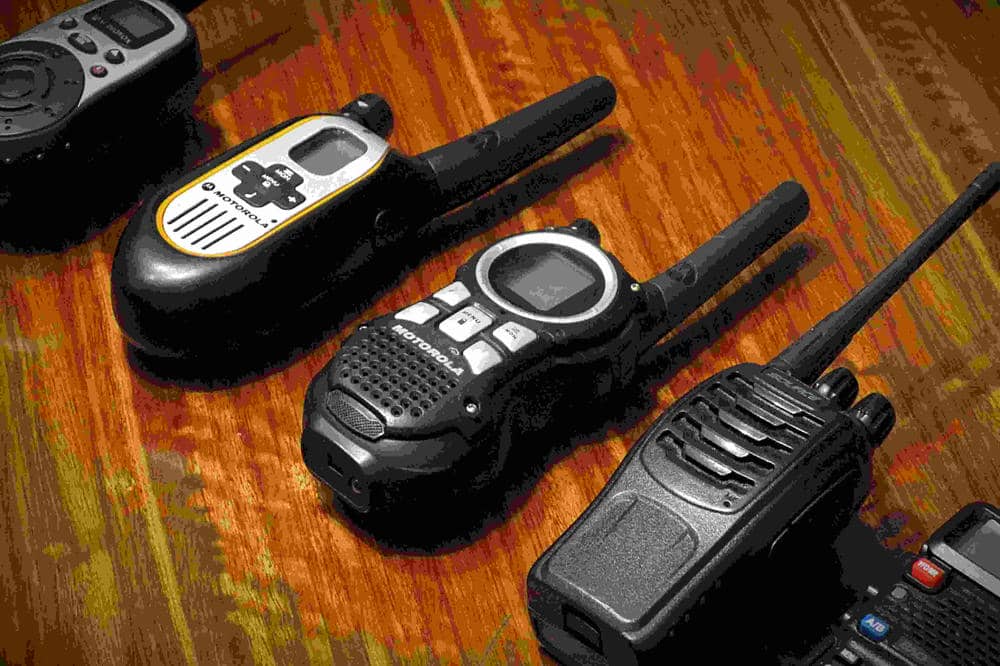
Handheld walkie-talkies are the most popular, all-purpose option. Compact, lightweight and rechargeable, they feature built-in core components and ergonomic design for one-handed, plug-and-play use with flexible channel switching.
Key Features: Lightweight, rechargeable, tool-free use, flexible channel switching
Typical Range: 1–3 miles (affected by power and environments)
Best Use Cases: Camping, hiking, family trips, retail, small construction, warehouse work, event security
Pros & Cons: Portable, cost-effective and easy to use; limited power and shorter range than fixed radios
1.2 Vehicle-Mounted Mobile Walkie-Talkies
Vehicle-mounted walkie-talkies are fixed on vehicles, boats and engineering equipment. Powered by vehicle batteries and paired with high-gain external antennas, they deliver stronger, more stable signals than handheld models for long-duration use.
Key Features: High power, stable signal, long continuous working time, long-distance coverage
Typical Range: 5–20 miles (open areas)
Best Use Cases: Fleet management, logistics, road patrols, engineering and marine operations
Pros & Cons: Ultra-stable long-range communication; non-portable, requires professional installation and higher budget
1.3 Base Station Walkie-Talkies
Base station walkie-talkies are fixed desktop devices for command and control centers. Equipped with high-power transmitters and directional antennas, they act as core communication hubs for large-area team scheduling.
Key Features: Maximum signal power, wide coverage, 24/7 stable operation, multi-channel management
Best Use Cases: Factory command centers, property control rooms, scenic area scheduling, emergency command stations
Pros & Cons: Excellent coverage and team manageability; bulky, fixed-position only, needs professional debugging
1.4 Repeater Walkie-Talkies
Repeaters are auxiliary signal amplification devices. They retransmit radio signals to eliminate blind spots, extend communication distance and connect multiple walkie-talkie teams.
Best Use Cases: Large industrial parks, mountainous areas, urban high-rise zones, super-large construction sites
2. Walkie-Talkies by Signal Technology
Walkie-talkies are divided into analog and digital types by signal technology, which determines audio clarity, anti-interference, privacy and functional richness.
2.1 Analog Walkie-Talkies
Analog walkie-talkies are traditional mainstream devices that transmit voice via frequency modulation. They feature simple operation, low cost and wide device compatibility.
Pros: Affordable, user-friendly, widely compatible, low maintenance cost
Cons: Weak anti-interference, single function, easy to eavesdrop, fuzzy long-distance audio
Suitable For: Budget basic communication for families and small teams
2.2 Digital Walkie-Talkies (DMR/P25)
Digital walkie-talkies (DMR/P25) convert voice to digital data for transmission, representing modern upgraded radio technology. They support encryption and diverse intelligent team call functions.
Pros: Clear audio, strong anti-interference, anti-eavesdropping encryption, supports group/single calls and text messages
Cons: Higher price, requires matching digital devices for full functions
Suitable For: Commercial teams, security, industrial sites and high-privacy scenarios
2.3 PoC Cellular Network Walkie-Talkies
PoC cellular walkie-talkies rely on 4G/5G networks, breaking the distance limit of traditional radios to support unlimited nationwide and global communication.
Key Features: No distance limit, cloud team management, real-time positioning, multi-team grouping
Suitable For: Cross-city fleets, long-distance logistics, national chain businesses
3. Walkie-Talkies by License Requirement
By regional radio regulations, walkie-talkies are split into license-free and licensed types, a core consideration for overseas users’ purchases.
3.1 License-Free Walkie-Talkies (FRS/PMR)
License-free walkie-talkies adopt free public bands (FRS for North America, PMR446 for Europe). Low-power and plug-and-play, they need no registration or fees.
Advantages: Zero usage threshold, legal out-of-the-box use, low cost, stable for daily communication
Limitations: Low transmission power and short communication range
Best For: Family outings, hiking, small shops and personal recreation
3.2 Licensed Commercial/GMRS Walkie-Talkies
Licensed GMRS/commercial walkie-talkies require official certification. With higher power and customizable bands, they deliver longer range, lower signal congestion and exclusive communication.
Advantages: Long range, anti-congestion, repeater-compatible, ideal for large team scheduling
Limitations: Requires license application and fees, subject to usage regulations
Best For: Enterprises, construction, security and professional outdoor teams
4. Specialized Walkie-Talkie Types for Specific Scenarios
Specialized walkie-talkies are tailored for extreme environments and niche usage scenarios with targeted functional upgrades:
4.1 Rugged & Waterproof Walkie-Talkies
Featuring IP67/IP68 waterproof, dustproof and drop-proof ratings, rugged walkie-talkies withstand rain, snow, seawater and collisions. Some floating models avoid water loss risks.
Application: Marine operations, field exploration, construction sites, ski resorts and bad-weather outdoor work
4.2 Long-Range High-Power Walkie-Talkies
High-power long-range walkie-talkies adopt 3–5W power and high-gain antennas, reducing obstacle signal attenuation to support ultra-long-distance communication in open areas.
Application: Mountain hiking, wilderness exploration, large farms and open construction sites
4.3 Kids Walkie-Talkies
Kids walkie-talkies are mini, lightweight and low-radiation, with simple buttons and fall-resistant designs for safe parent-child interaction and children’s outdoor games.
Features: Kid-friendly interface, long battery life, clear low-interference audio, drop resistance
4.4 Bluetooth Walkie-Talkies
Bluetooth walkie-talkies support wireless headset connection for hands-free operation. Most can pair with mobile apps for channel management and positioning viewing.
Application: Cycling, driving, security patrols and all hands-free working scenarios
5. How to Choose the Right Walkie-Talkie? Quick Buying Tips
Follow these 4 core criteria to quickly select a suitable walkie-talkie:
Usage Scenario: Handheld models for daily outdoor and retail use; vehicle-mounted/base station models for long-distance and large-area scheduling
Communication Distance: License-free low-power radios for 1–3 mile short-range daily use; high-power licensed/PoC radios for long-distance industrial use
Working Environment: Choose IP-rated rugged waterproof radios for outdoor extreme and harsh environments
Privacy & Stability: Opt for encrypted digital walkie-talkies for business use to avoid interference and eavesdropping
Final Words
Walkie-talkies cover diverse types for recreational, commercial and industrial needs, with unique strengths for different scenarios. You can easily find cost-effective devices by sorting them by form factor, technology, license rules and specialized functions.
Whether you need portable outdoor radios, encrypted business radios or rugged waterproof devices, a matched walkie-talkie will greatly boost your team communication efficiency and safety.But please remember higher pricing never means better performance,the most suitable one is always the best.




 IPv6 network supported

 Get a Quote