
leave a message
If you are interested in our products and want to know more details,please leave a message here,we will reply you as soon as we can.
The global professional wireless communications market is undergoing a profound structural transformation.
The global two‑way radio market was estimated at USD 10.52 billion in 2025 and is expected to reach USD 14.47 billion by 2030, growing at a compound annual growth rate (CAGR) of 6.59%.
The portable digital two‑way radio segment alone was valued at approximately USD 3.47 billion in 2025, with projections to reach USD 4.80 billion by 2031 at a CAGR of 4.8%.
The core Digital Mobile Radio (DMR) market expanded from USD 7.04 billion in 2024 to USD 7.84 billion in 2025, an impressive CAGR of 11.5%. Analysts project it will reach USD 11.78 billion by 2029 (CAGR 10.7%).
The broader Professional Mobile Radio (PMR) market is also on a strong growth trajectory, expected to grow from USD 20.57 billion in 2025 to USD 28.29 billion by 2029 at a CAGR of 8.3%.
Digital technology has firmly established itself as the dominant force, commanding over 55% market share in the two‑way radio equipment sector. Across public safety, utilities, commerce, and industrial segments, organizations are rapidly migrating from legacy analog systems.
The clear takeaway: Digital technology has become the sole technical direction for professional wireless communications. The question is no longer whether to transition, but when and how.
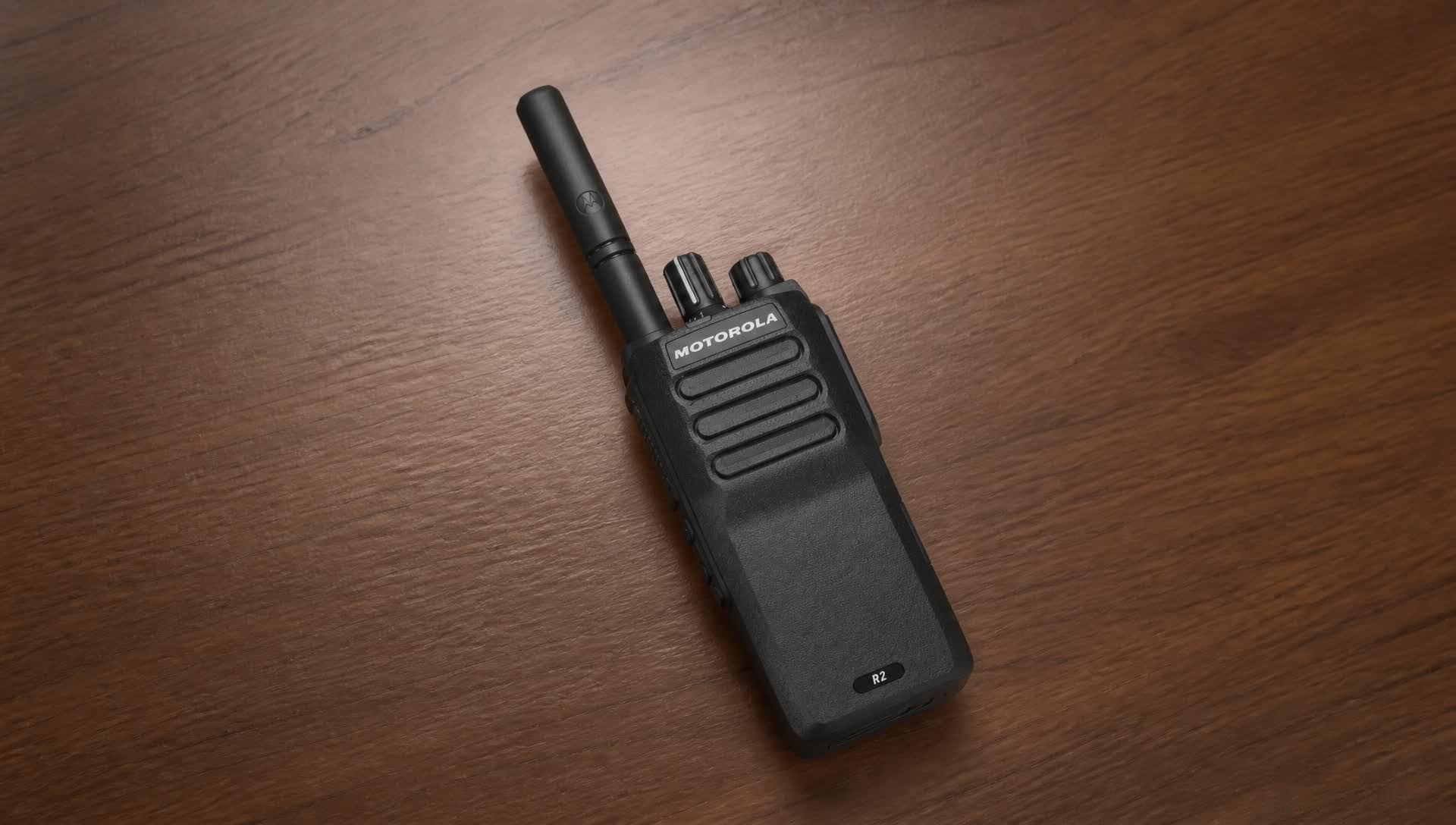
The fundamental difference between analog and digital two‑way radios lies in how voice signals are transmitted.
Analog Radios – The Legacy Approach
Use continuous waveform modulation, directly loading voice signals onto RF carriers.
Advantages: Low cost, plug‑and‑play usability, strong backward compatibility with older equipment.
Critical limitations:
Low spectral efficiency – only one conversation per frequency channel.
Poor noise immunity – signal degradation, interference, and crosstalk worsen in complex electromagnetic environments or over longer distances.
No inherent encryption – communications are vulnerable to interception.
Digital Radios – The Modern Standard
Digital systems convert voice into digital data packets, then decode and reconstruct audio at the receiving end. This delivers fundamental performance improvements across every key metric:
Voice Quality: Advanced codecs actively filter background noise. Built‑in error correction ensures less noise and greater clarity even in high‑noise environments such as construction sites, factories, or during severe weather.
Spectral Efficiency: TDMA (Time‑Division Multiple Access) divides a 12.5 kHz channel into two timeslots – enabling two simultaneous conversations on one frequency, effectively doubling capacity. One digital repeater replaces two analog ones, significantly reducing infrastructure costs.
Security: Supports AES‑256 encryption (P25‑compliant, FIPS‑certified), providing government‑grade protection. Analog radios rely only on CTCSS/DTCS tone codes – offering no true encryption.
Battery Life: TDMA operation uses only half the battery power per transmission, delivering up to 40% longer runtime per charge. Typical analog radios provide 8–12 hours; digital models deliver 12–16 hours.
Device Longevity: Analog equipment typically lasts 3–5 years, while digital radios are built for 5–8 years of reliable service – offering better total cost of ownership over the long term.
Analog radios are fundamentally limited to basic voice communication and cannot meet the diverse operational needs of modern teams. Digital radios, however, enable a “voice + data” dual‑mode operation, integrating capabilities such as:
GPS positioning – real‑time fleet and asset tracking.
Text messaging – silent, discrete communication and group broadcasting.
Bluetooth connectivity – hands‑free operation and peripheral integration.
Emergency alerting – instant panic buttons and location sharing.
Real‑World Applications
Logistics and fleet management – track vehicle positions while simultaneously pushing routing instructions.
Equipment maintenance – receive automatic alarm work orders and coordinate rapid repair responses.
Emergency response – broadcast critical alerts and location information to dispersed personnel instantly.
Moreover, digital radios can integrate with video surveillance and emergency broadcast systems, creating comprehensive dispatch networks. The evolution is moving toward multi‑modal converged communications:
Artificial Intelligence is being embedded to provide advanced noise cancellation, maintaining clarity in extreme noise environments.
AI‑powered voice‑to‑text and keyword search enhance dispatch efficiency and post‑event analysis.
Public‑private hybrid and multi‑mode communications (e.g., LTE/DMR convergence) are becoming the mainstream direction, enabling seamless roaming between professional and commercial networks.
Beyond technological merits, government mandates are a powerful force pushing organizations toward digital adoption.
In the United States, the FCC’s VHF/UHF narrowbanding deadline (January 1, 2013) required all private land mobile radio (PLMR) licensees in the 150–174 MHz and 450–512 MHz bands to operate with channel bandwidth of no more than 12.5 kHz – effectively making wideband analog operations non‑compliant.
In China, the Ministry of Industry and Information Technology (MIIT) has mandated that from 2025 onward, non‑public two‑way radios operating in the 400 MHz band must support digital formats. Analog equipment type approvals have been phased out, and professional sectors are rapidly retiring legacy analog devices.
Choosing digital two‑way radios is therefore not merely a technological upgrade – it is a regulatory necessity for organizations that wish to remain compliant and avoid operational disruptions.
From being able to communicate to communicating clearly, securely, and efficiently, digital two‑way radios are fundamentally redefining the standards of professional wireless communications.
Analog radios served their purpose in a previous era – offering low entry cost and basic voice functionality. However, they come with significant drawbacks: vulnerability to interference, lack of security, low spectral efficiency, and shorter device lifespan.
Digital radios, in contrast, deliver holistic performance advantages:
Crystal‑clear audio even in noisy environments,
Doubled channel capacity through TDMA,
Robust AES‑256 encryption,
Extended battery life and longer equipment service life,
Rich data capabilities that enable smarter operations.
These benefits make digital two‑way radios indispensable infrastructure for digitally transforming enterprises and public safety agencies alike. For organizations pursuing efficient team coordination, secure operations, and long‑term cost savings, choosing digital two‑way radios means choosing a future‑ready communications foundation – a competitive necessity in an increasingly connected and demanding world.



 IPv6 network supported

 Get a Quote